Hey there! If you’ve ever stared at your phone dying mid-road trip and thought, “Man, a wireless charger would fix this,” you’ve probably wondered something super basic: do these things actually work with every phone out there? As someone who’s been selling car wireless chargers for a few years now, I’ve heard that question a lot—from random drivers at trade shows to regulars sliding into our shop asking if they can finally ditch those tangly charging cables. Let’s cut through the noise, no tech jargon, and break this down like I’d chat with a friend over a coffee. Car Wireless Chargers

First off, let’s get the big answer out of the way right quick: no, not every car wireless charger works with every phone. But before you go tossing your old charger in the trash, there’s way more to it than just “my iPhone won’t pair with my Samsung’s charger.” Let’s start with the tech that makes wireless charging tick—because that’s where the confusion lives. Most wireless chargers you’ll find for cars use Qi charging, right? That’s the standard almost every big phone maker uses now—Apple, Samsung, Google, even budget brands like Motorola or Nokia. But Qi isn’t a magic “works for everything” button. It’s got specific rules, and your phone and charger have to line up on a few of them to play nice.
Wait, let’s talk about power output first. Your phone’s battery isn’t the same size, and it doesn’t charge at the same speed, regardless of how fancy the charger is. For example, my phone’s a 15-pro-max—Apple says it charges wirelessly at up to 15W. If you plug that into a car wireless charger that only puts out 5W, you’re gonna wait twice as long to get from 20% to 80% than if you used a 15W charger. But here’s the thing: if your charger puts out too much power for your phone, that can actually cause problems, not just be slow. A lot of older budget Android phones max out at 10W, and if you stick a 15W charger on them, they’ll either throttle back to 10W or even shut down temporarily to prevent overheating. We’ve had customers come in with old phones asking why the charger isn’t working, and nine times out of ten, it’s a power mismatch, not a broken charger.
Then there’s the weird case of phones that don’t support Qi at all. Wait, does that even happen anymore? Yeah, surprisingly—some really old flip phones, super niche rugged phones, or even a few budget Android models from like 8+ years ago skip Qi charging entirely. If you’ve got a 2015 Samsung Galaxy S6 or earlier, you’re out of luck unless you add a Qi receiver case. But almost every phone released in the last 6 or 7 years has Qi built in, so that’s less of a worry these days. I’ve seen people panicking because their brand-new phone didn’t work, only to realize they grabbed a charger that’s only for Apple—wait, no, Qi is universal for the most part, but some chargers are “optimized” for specific brands. We stopped doing that a while back because customers kept bringing back chargers that didn’t work with their non-Apple phones. Now all our chargers are Qi-certified, so they work with any Qi-enabled phone, but I still get the occasional confused email from someone who bought a no-name charger off Amazon that only lists “for iPhones” or “for Samsung” like it’s a separate club.
Now, let’s get into the car-specific stuff, because that’s a whole other layer. Even if your phone and charger are perfect matches, your car’s setup might mess things up. A lot of modern cars have metal parts in the dashboard—like the trim around the air vents, or the metal backing on some touchscreens. If your charger is mounted too close to metal, it can interfere with the charging coil in your phone, or even block the charger’s own coil from working. We had a customer last month who kept saying our charger was garbage because his phone would stop charging every time he turned on the AC. Turned out the AC knob’s metal base was right behind where he mounted the charger—he shifted the charger a couple inches away, and it worked like a charm. Also, car cases! That’s a big one. If your phone’s got a thick case—like a heavy-duty OtterBox for construction work, or a wallet case with a bunch of credit cards in it—the cards can block the wireless charge, and the thick case might create too much distance between the phone’s coil and the charger’s coil. We recommend slim cases (under 3mm) for best results, but we’ve made our newer chargers with extra-powerful coils that work through up to 5mm, so even a little thicker case is fine. That’s a change we made after hearing dozens of customers complain their wallet case wouldn’t work—we listened, built a better charger, and now it’s way less of a problem.
Wait, what about fast charging vs. regular charging? Let’s clarify that. If your phone supports fast wireless charging, the charger has to have that same fast charging standard to get that speed. For example, Samsung uses their own Fast Wireless Charging 2.0, and Google uses Warp Charge for some of their Pixel models. Qi charging is the base, but those are proprietary extensions that make fast charging work. The good news is most modern Qi chargers (the ones we sell, anyway) support all those standards now—we test every charger with iPhones, Samsungs, Pixels, and even some OnePlus phones before we put them on our site. But if you buy a random no-name charger that only says “Qi Compatible,” it might not support those fast standards, so you’ll get slow charging even if your phone can do fast. That’s another common mix-up—people think “Qi means fast,” which isn’t always true.
Let’s talk about compatibility horror stories I’ve actually dealt with, to make this real. Last year, a guy came in with a brand-new Google Pixel 7 and an old wireless charger he’d had for his 2020 iPhone. He plugged it in, and the phone flashed a “charging not supported” error—he thought the charger was broken, but it was just the old charger not supporting Google’s fast wireless standard. We gave him a newer Qi charger that supports all major brands, and it worked on his Pixel right away, even with his thick case. Another time, a woman had an iPhone 12, and her charger would only charge if the phone was sitting exactly centered. She was putting her phone off-center to adjust her GPS, so it kept stopping. We showed her how our chargers have alignment guides (not just a random pad) that make the coils line up automatically, so even if she shifts the phone a little, it still charges. That’s the kind of small detail that people don’t think about when they buy a cheap charger—cheap ones have weak coils that need perfect alignment, while good ones have stronger coils that forgive a little off-center placement.
Now, what if you do have a phone that won’t work with wireless charging at all? Is there a work-around? Yeah, but it’s not ideal. You can get a Qi receiver that plugs into your phone’s USB-C or Lightning port, then stick it between your phone and your case. But that adds bulk, and it’s a little flimsy—we only recommend that for people with super old phones that don’t have Qi built in. We don’t even sell those because most people don’t need them anymore, and the ones we’ve tested are more trouble than they’re worth. If you’re in that tiny group of people with a non-Qi phone, you’re better off sticking to a regular cable, no two ways about it.
Wait, let’s wrap this up with what this means for you. If you’re shopping for a car wireless charger, the main things to check are: is it Qi-certified? Does it support your phone’s power needs (if your phone does fast wireless charging, make sure the charger does too)? And does it have a strong coil that works through cases and isn’t finicky about alignment. For us, we built our chargers exactly because we were tired of seeing people get ripped off by chargers that only work with specific phones, or break after a month. We test every unit to make sure it works with iPhones, Samsungs, Pixels, OnePluses, and even budget phones, so you don’t have to guess.
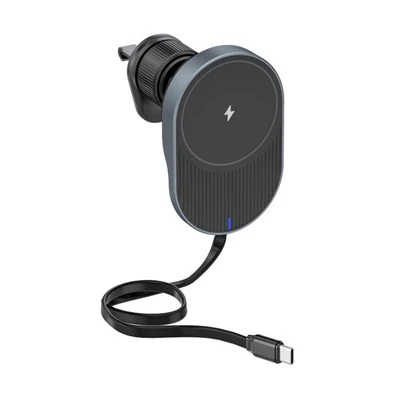
And hey, if you’re looking to stock these for your business—whether you’re a car accessory shop, a fleet operator, or an online retailer—we’ve got bulk pricing and custom options, no minimums for small orders, and we stand behind every charger we make. No hoops to jump through, no complicated contracts. Just a reliable product that works for almost every phone, and a team that’s here to answer any questions you’ve got, whether you’re a first-time buyer or a regular. If you’re ready to talk numbers and make this work for your business, just reach out—we’re all ears.
Car Vacuum Cleaner References
- Wireless Power Consortium. (2024). Qi System Overview. Retrieved from wirelesspowerconsortium.com
- Apple Inc. (2023). iPhone Wireless Charging Specifications. Apple Support.
- Samsung Electronics. (2024). Fast Wireless Charging Standards for Galaxy Devices. Samsung Mobile Support.
- Google LLC. (2023). Pixel Phone Wireless Charging Capabilities. Google Help Center.
- Consumer Reports. (2022). What to Look for in a Car Wireless Charger. Retrieved from consumerreports.com
KOMOS Co., Ltd.
As one of the most professional car wireless chargers manufacturers and suppliers in China, we are committed to providing high quality custom service and OEM service. Please feel free to wholesale bulk durable car wireless chargers at competitive price from our factory. Welcome to contact us for quotation.
Address: 4th Floor, Building 3, Zhongxi Buchong Community, Shajing Street, Bao’an District, Shenzhen City, Guangdong Province, China 518104
E-mail: contact@komos-tech.com
WebSite: https://www.komos-tech.com/
